Connecting students to industry standards using a Blackmagic Design solution.
Fremont, CA, USA - Blackmagic Design today announced that Bournemouth University has adopted an interconnected Blackmagic Design live production workflow to deliver its new BSc in Esports Digital Technologies, giving students hands on experience in acquisition, control and delivery.
Andrew Kitchenham, deputy head of the Creative Technology Department, leads the program. “We designed it around real production roles,” said Kitchenham. “It’s about the infrastructure and the people who operate it: engineering, production, tech ops, project management and commercial.”

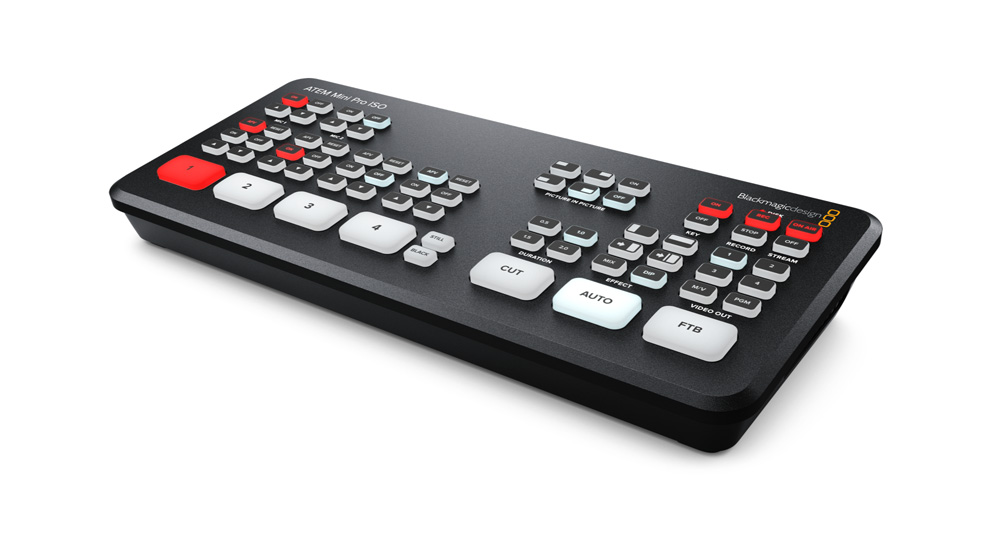
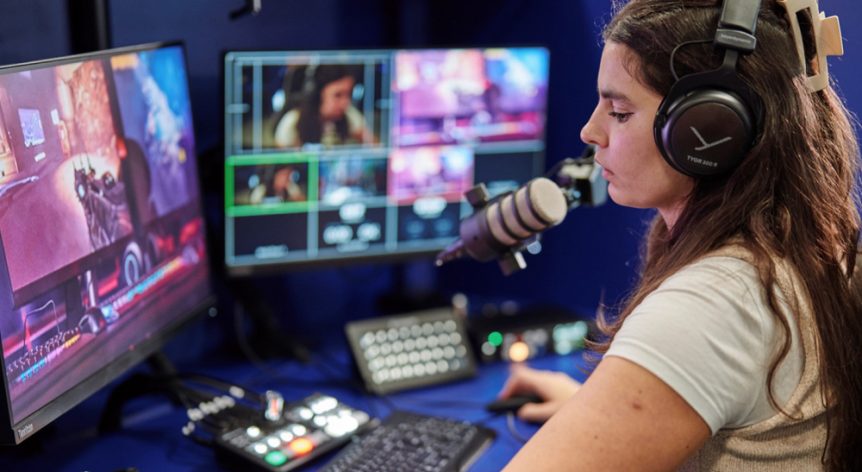
Each student workstation centers on an ATEM Mini Pro ISO for multi source live production switching and ISO recording, paired with a Blackmagic Micro Studio Camera 4K G2 to capture the player, a HyperDeck Studio HD Plus broadcast deck for playback and graphics, a direct PC feed for gameplay or motion graphics and a fourth input routed via a centrally installed Blackmagic Videohub 20x20 12G router.
The lab is built on SDI connectivity for high quality routing between stations, with more than 75 SDI cables beneath the floor and custom patch bays for flexible signal management. “One of the goals from day one was making sure the teaching team could route any output to all other students’ booths,” said Kitchenham. “The Videohub became invaluable for that, turning what looks like a simple classroom into a fully interconnected production space.”
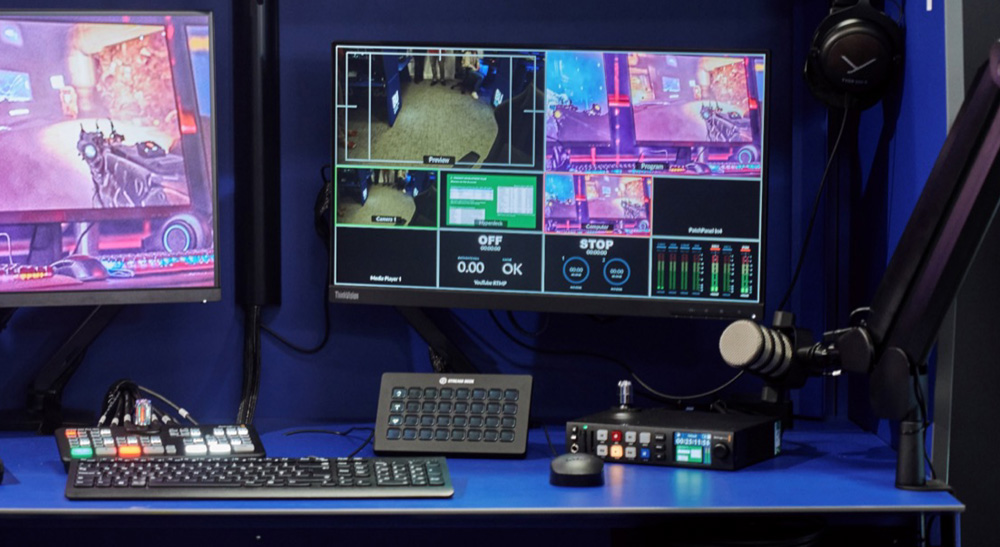
To build operational fluency, the facility integrates Bitfocus Companion and Stream Deck for scripted automation, enabling students to create macros, switch cameras, trigger graphics and control playback. Kitchenham noted, “We’re teaching scripting logic, how to build environments using macros and understanding network protocols. A huge leap in capability compared to just pressing record.”
Following productions, ATEM Mini Pro ISO recordings and project files open directly in DaVinci Resolve Studio for editorial and finishing. “The DaVinci Resolve integration was a big part of the decision,” said Kitchenham. “Students can revisit their entire show, re edit with synced camera feeds and produce professional level output. It’s the kind of skill the industry is looking for.”
Kitchenham added that the distributed lab model keeps every student engaged on identical tools from day one. “The idea is to get every student working on the same equipment simultaneously,” he concluded. “If only three students in a class get to touch a vision mixer, the rest are passively watching. That isn’t how we want to teach. We needed an active learning environment where everyone is hands on.”